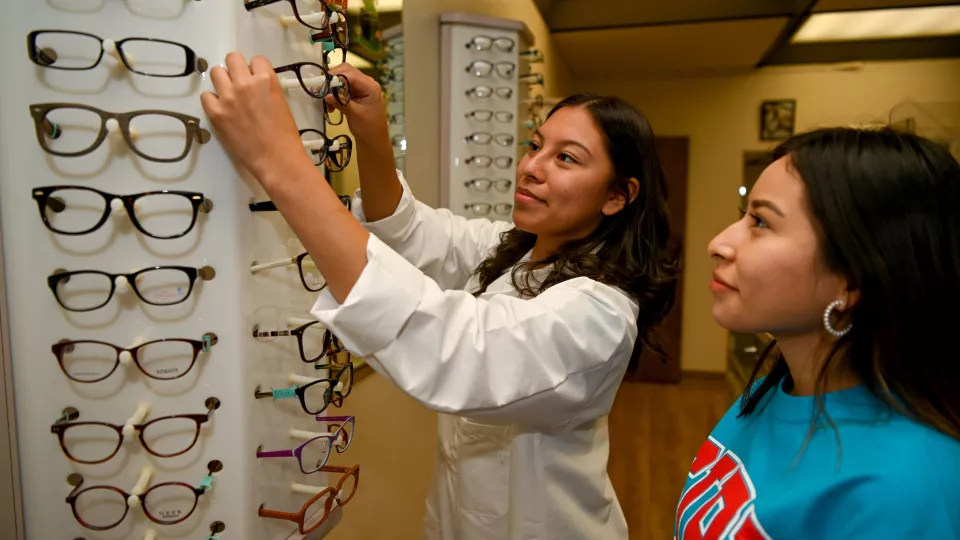
ALBUQUERQUE, NM – The Southwestern Indian Polytechnic Institute Vision Care Program is opening doors for Native students to enter high-demand health professions while supporting the delivery of essential services in tribal communities. As part of the Bureau of Indian Education’s efforts to expand career pathways and prepare students for success in today’s workforce, the program offers practical training that leads directly to employment and promotes long-term economic stability for Native families and nations.
“The Trump Administration has prioritized equipping American workers with marketable skills to fill the growing demand for trained professionals,” said Assistant Secretary for Indian Affairs Billy Kirkland. “By empowering Native students to enter the workforce with these technical skills, SIPI is strengthening tribal economies while helping to make services more accessible in tribal communities, bolstering efforts to make America healthy again.”
The BIE continues to invest in programs that create strong learning environments and modern training opportunities for students. SIPI’s administration plays a key role in this work by providing the resources and facilities needed for students to develop workforce-ready skills.
“SIPI’s commitment to rigorous training and community service ensures graduates leave ready to meet the needs of their home communities,” said BIE Director Tony Dearman. “This program reflects our mission to empower students with education that builds tribal workforce capacity now and for future generations.”
Accredited by the Commission on Opticianry Accreditation, SIPI’s Vision Care Program trains students to work in states requiring licensure. Coursework includes prescription analysis, frame selection, lens fabrication, and clinic-based pretesting. Students also complete the American Board of Opticianry certification, which prepares them for immediate employment. The program has maintained a 100 percent employment rate in recent years, underscoring its strong preparation for professional careers.
Hands-on learning remains central to the training. Students use advanced ophthalmic equipment and participate in full clinical workflows, from capturing retinal images to assisting with eye exams. The campus eyeglass store further strengthens student skills by simulating a working optical environment informed by the cultural design of surrounding tribal communities.
Community outreach is also a defining element. Students participate in vision screenings, glasses repairs, and frame fittings at nearby pueblos and tribal health fairs. For more than five years, they have partnered with Special Olympics New Mexico to provide free glasses and fittings for athletes, gaining experience with a wide range of optical needs.
Graduates frequently return to serve their home communities. One alum from Santo Domingo Pueblo used her Kewa language to help elders more comfortably navigate eye exams, demonstrating how culturally responsive care enhances communication and preserves tribal knowledge.
SIPI instructor Eric Garcia notes the strong local reputation the program has earned over time, both among employers and within the community. Its impact is evident across the region and reflected in the success of its graduates.
“It’s hard to go to an eye care office in New Mexico and not find a SIPI alum working there,” Garcia said. “That’s a testament to the program and to the students who carry these skills back to their communities.”
With its emphasis on workforce preparation, community service, and culturally informed learning, the SIPI Vision Care Program continues to expand opportunities for Native students and strengthen health care capacity across Indian Country.
Learn more about the Southwestern Indian Polytechnic Institute Vision Care Program at SIPI.edu.
Contact
Office of Communications
Bureau of Indian Education Central Office
U.S. Department of the Interior
1849 C Street NW, MIB-3610
Washington, DC 20240
Telephone: 202-941-0789
Email: biecommunications@bie.edu